Blacksmithing for Beginners in the UK: Everything You Need to Start
Blacksmithing is more accessible than most people think. You don't need a converted barn or a five-figure budget to start forging metal at home. With the right forge, a handful of basic tools, and some genuine practice, you can create practical metalwork within weeks.
The UK has seen a quiet resurgence in hobby blacksmithing over the past decade. Partly it's nostalgia. Partly it's the appeal of making something tangible with your own hands. But mostly, people discover it's genuinely satisfying work that teaches you something useful about materials and craft.
This guide covers what actually matters when you're starting out: choosing a forge type, understanding which tools are non-negotiable, the fundamental skills worth learning first, and the practical constraints of working in the UK climate and on a typical UK-sized property.
Forge Types for Home Blacksmithing
Your forge choice shapes everything else about your setup, so this decision matters.
Coal forges are the traditional option and still popular with hobbyists. They're simple — just a metal pan with a chimney — and coal is readily available from UK suppliers. The main advantage is that coal burns hot enough for almost everything you'll forge, and it's predictable once you've learned to manage it. The drawback is heat distribution. You get a small, intense hot zone, which means moving your work around the fire often. Coal also produces significant smoke and ash, which matters if you're close to neighbours.
Gas forges are increasingly common among beginners. A burner heats a steel chamber lined with refractory brick, and you control temperature by adjusting the gas. They're cleaner than coal, reach good working temperatures quickly, and give you more even heat across your work. Downsides: higher initial cost (£400–800 for a decent single-burner forge), ongoing fuel expense, and you need a decent workspace to store a propane or butane bottle safely. Gas forges also need good insulation to work efficiently in British winter conditions.
Coke forges split the difference: similar to coal forges but burn coke (processed coal), which is cleaner and slightly hotter. Less common now, and availability varies by region.
For most UK beginners with limited space and neighbours nearby, a gas forge is the pragmatic choice. If you have an outbuilding and don't mind the mess, a coal forge costs less upfront.
Essential Tools You Actually Need
This is where many beginners overspend. You don't need twenty hammers.
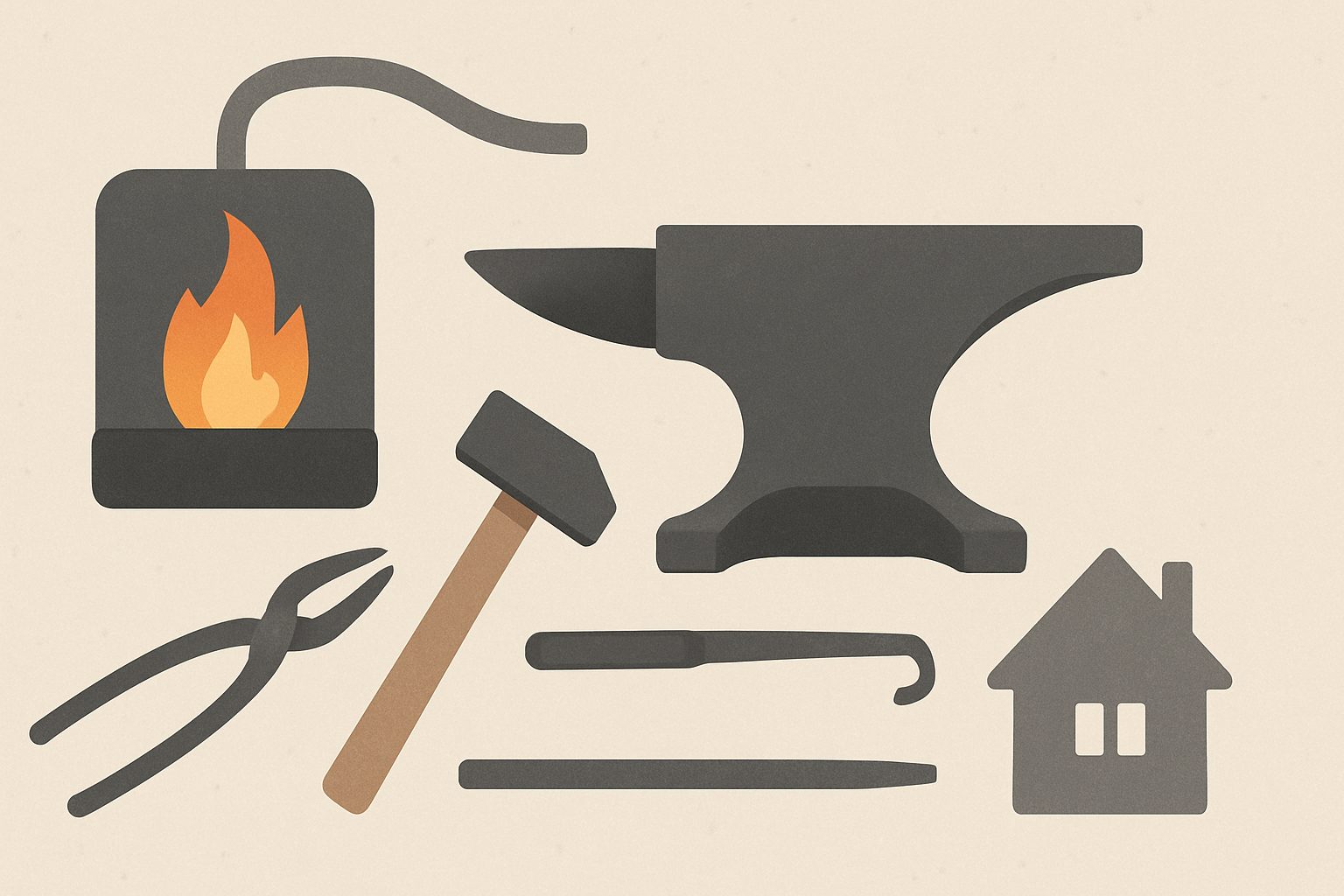
Forge — Your primary tool, covered above.
Hammers — A 2–2.5 lb cross-peen hammer is your main working hammer. That's it. You'll use this for almost everything. Some people add a 1.5 lb for detail work, but you can start with one good hammer. Expect to spend £40–80 on a proper tool-steel hammer.
Anvil — This is your second biggest expense. A cast-steel anvil (80–100 lbs) costs £150–300. You don't need a 200 lb vintage London pattern anvil. A smaller anvil works fine for jewellery and small tools. If budget is tight, some beginners use a steel block or railroad anvil as a temporary base, though neither is ideal long-term.
Tongs — Buy one general-purpose pair to start (around £30–50). Flat-sided or V-jaw tongs grip most work. You can make specialist tongs later once you know what you actually need.
Hardy tools — These are cubes with square shanks that slot into your anvil's hardy hole. A basic set includes a hardy stake and a bending tool. You can start with just a stake. Total cost: £20–40.
Chisels and fullers — Cold chisels for cutting and fullers for decorative work. Start with one cold chisel and add others when you have a specific project.
Quenching bucket — A 20-litre container filled with water. New: about £10. Old bucket from anywhere: free.
Apron and gloves — Heat-resistant leather is essential. Budget £20–40. Cotton work gloves and steel-toed boots round out safety basics.
Most people spend £400–700 total on entry-level tools if they start with a gas forge, or £250–400 with a coal forge.
The Skills Worth Learning First
You don't need to master ornamental scrollwork or Damascus steel before you can make something useful.
Drawing down is the fundamental skill: using your hammer and anvil to take a section of steel and lengthen it by narrowing the cross-section. Almost every piece starts this way. It teaches you heat management, hammer control, and how steel behaves.
Bending and twisting come next. Once you can manipulate heated steel confidently, you can create hooks, rings, handles, and decorative elements.
Upsetting (thickening a section of steel) and tapering round out the core techniques. These four skills — drawing, bending, upsetting, and tapering — let you make practical tools and simple decorative work.
Fire management matters as much as hammer work. Learning to read heat colour and know when your metal is workable prevents brittle work and wasted fuel.
Space, Safety, and UK Practicalities
Blacksmithing generates heat, noise, and fumes. In the UK, this means considering your neighbours, your garden setup, and the season.
A small workshop (10 × 12 feet) is enough for a single forge, anvil, and basic tooling. You need good ventilation: either a chimney for coal, or a vent hood for gas. Many UK hobbyists set up in sheds or converted garages.
Winter temperatures can affect gas forge efficiency — insulation and a slightly larger burner help. Dampness is worth managing; tools rust in unheated spaces, and damp makes metalwork tedious.
Fire safety is real but straightforward. Your forge needs a concrete or stone floor. Keep a water bucket nearby. Wear appropriate clothing (cotton or leather, never synthetics). If you're burning coal, inform local residents; smoke is a legitimate nuisance, and keeping good relations matters.
Check your insurance. Some home policies don't cover workshop activities. A few insurers specialise in craft insurance and will cover you for £15–30 extra per year.
Getting Started Practically
Join a club or take a course first if you can. The UK has regional blacksmithing associations, and weekend courses cost £100–150. You'll learn faster with someone watching your technique, and you'll confirm you actually enjoy it before spending on equipment.
Once you're committed, start small. Buy your forge and basic tools, then spend a month just drawing down scrap steel. Make ugly things. Learn how your hands work. Then move on to projects.
Your first projects needn't be fancy: a basic hook, a simple spatula, a fire poker. These teach you everything you need while producing something genuinely functional.
What Comes Next
Once you understand the fundamentals, you'll want guidance on specific topics. We've written detailed guides on forge types and safety that cover the nuances for UK setups. There's also a complete rundown of workshop setup if you're planning a dedicated space.
Blacksmithing rewards patience and repetition. The good news is you'll have something real to show for it.
More options
- Devil Forge Propane Gas Forge (Single & Double Burner) (Amazon UK)
- Blacksmithing Anvil (Cast Steel, 55–110 lb) (Amazon UK)
- Ceramic Fibre Blanket Refractory Wool (Kaowool 2600) (Amazon UK)
- Blacksmithing Tongs and Hammer Starter Set (Amazon UK)
- Leather Blacksmith Apron and Welding Gloves PPE Bundle (Amazon UK)